
Does A Nigerian Minister Rank Higher Than The Chief Of Naval Staff?
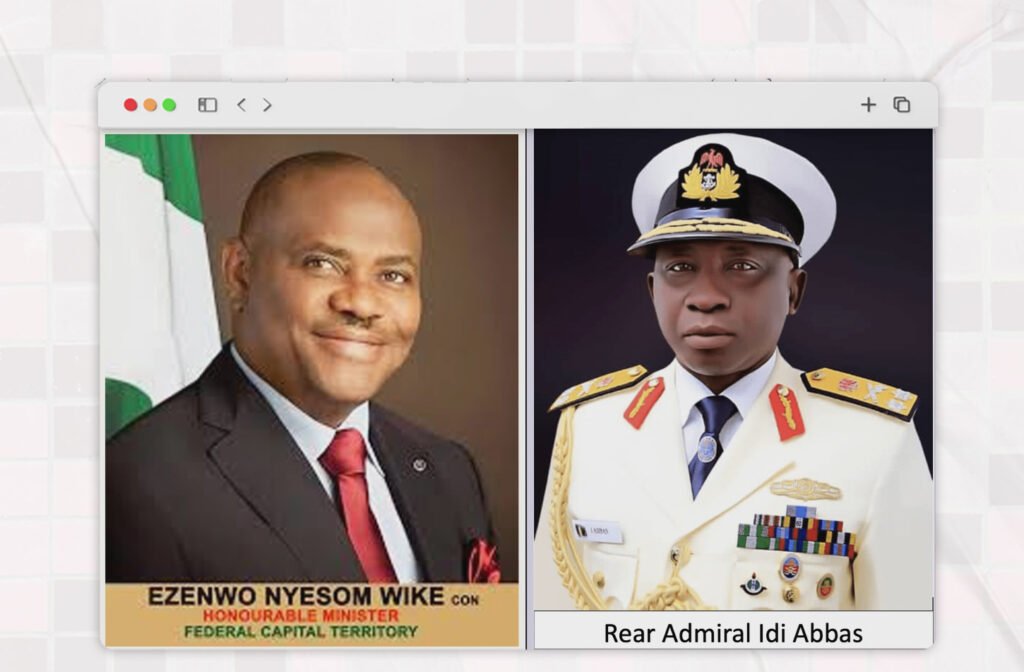
A viral altercation between the minister of the Federal Capital Territory, Nyesom Wike and a Nigerian Navy personnel, Lt. A. M. Yerima, has led to heated social media debates on who is more superior between a minister and the Chief of Naval Staff. In the 6 minutes 54 seconds video, the military personnel blocked the FCT minister from gaining access to a parcel of land, thereby leading to tension between both parties.
Constitutional And Legal Basis
Under the Armed Forces Act (Cap A20) Laws of the Federation of Nigeria 2004, the Minister of Defence is defined as the head of the Ministry of Defence, and the service chiefs (Army, Navy, Air) report indirectly through the military chain to that ministry. The ministry’s website states the Minister is the “Chief Executive of the Ministry” and the Permanent Secretary is the accounting/administrative head. The military components are supervised by the Defence Headquarters, but still under the minister’s umbrella.
In a commentary by human rights lawyer Femi Falana, SAN, it is stated that “the Minister of Defence is higher than the Chief of Defense Staff, CDS, and the service chiefs in the ranking. The service chiefs are answerable to the minister of defence, pursuant to sections 9, 12 and 15 of the Armed Forces Act.”
Institutional And Operational Hierarchy
According to the structure of the Nigerian Navy and the Armed Forces, the service chiefs including the Chief of Naval Staff, reports to the CDS. The CDS in turn reports to the Minister of Defence, and through the Minister to the President, as Commander-in-Chief.
The minister has administrative oversight, budgetary control, policy formulation responsibility for defence, while the service chiefs have operational command over their individual services. For example, a document from Stockholm International Peace Research Institute, SIPRI, states that the ministry, led by the minister, is responsible for formulation and execution of national defence policy, whereas the CDS is the chief military adviser.
Practical Implications
A recent official ceremony shows the Minister of Defence, Mohammed Badaru Abubakar, receiving the newly‐appointed CDS and service chiefs at his office. The fact that it is the minister who hosts them shows his supervisory role.
The minister chairs or plays a leading role in councils such as the National Defence Council and Armed Forces Council, where service chiefs are members but the minister holds a higher chair role. Falana noted that the minister is “chairman while the CDS is vice-chairman of the Army Council, Navy Board and Air Council.”
In promotion ceremonies, the minister oversees events such as decoration of military officers, further evidencing the minister’s higher function.