

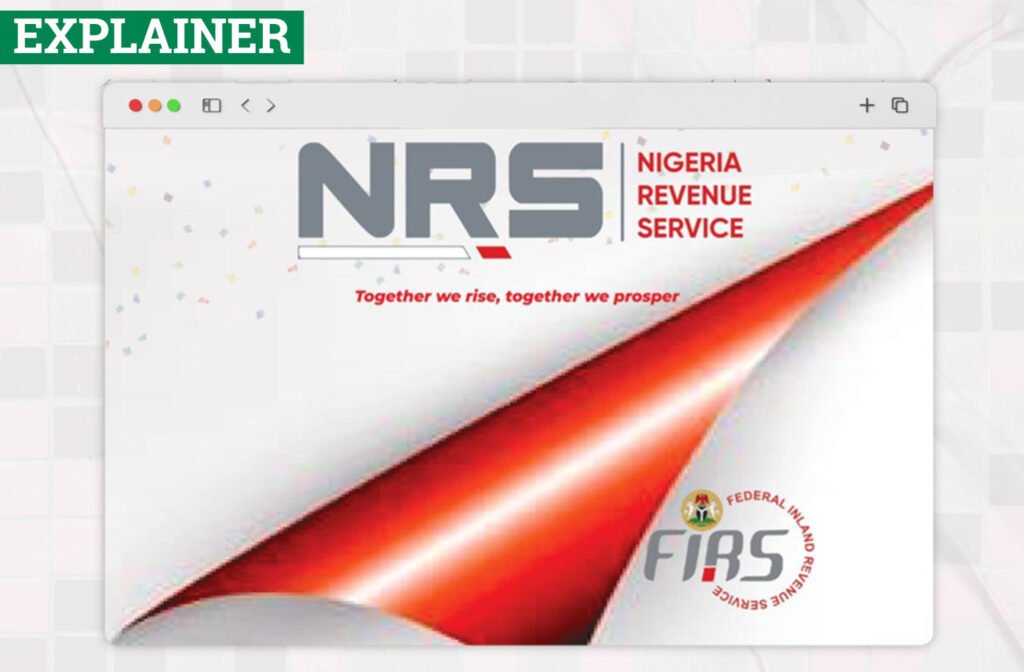
Understanding New Tax Regime As FIRS Changes Name To National Revenue Service
On January 1, The Federal Inland Revenue Service, FIRS, was formally replaced by the Nigeria Revenue Service, NRS, as Nigeria’s central revenue authority.
This change stems from the Nigeria Revenue Service (Establishment) Act, 2025, which repealed the old FIRS Act (2007) and created the NRS with a new legal foundation and mandate.
What It Means
This is not just a name change. The NRS is conceived as a modernised, autonomous agency with a broader revenue administration role.
The rebrand also included the unveiling of a new logo and corporate identity on 31 December 2025 before the new system went live.
New Tax Laws Passed In 2025
In June 2025, President Bola Tinubu signed four major tax reform bills into law to overhaul Nigeria’s fragmented tax regime. They are:
- Nigeria Tax Act (NTA) — Consolidates various tax laws into a unified statute.
- Nigeria Tax Administration Act (NTAA) — Governs how taxes are administered and enforced.
- Nigeria Revenue Service (Establishment) Act — Replaces FIRS with NRS and sets its powers/mandate.
- Joint Revenue Board (Establishment) Act — Establishes a framework for revenue coordination among federal, state, and local governments.
What Has Been Consolidated?
Prior to these reforms, Nigeria’s tax system relied on over 70 separate tax provisions and levies, spread across multiple laws and regulatory instruments. The Nigeria Tax Act reorganises these into a single, streamlined tax code, making compliance simpler and more transparent.
Some historically separate charges like Tertiary Education Tax, various agency levies, and others are now restructured under a single development levy concept to reduce unpredictability and compliance burdens. While existing VAT and CIT statutes remain in force, their administration is now more coherent under the new regime.
Expanded Mandate Of The NRS
Unlike the old FIRS, the NRS is empowered to:
- Administer tax laws.
- Collect non-tax revenues and ensure they are remitted properly.
- Coordinate revenue administration across federal, state, and local government levels.
- Centralise taxpayer registration and data systems.
- Improve digital platforms for filing and payment.
- Strengthen enforcement and compliance mechanisms.
This centralisation is aimed at eliminating duplicative systems and revenue leakages.
Key Changes Under The New Regime
Existing Tax Identification Numbers (TINs) remain valid, but NRS will increasingly digitise compliance systems. Filing and payment processes will shift toward more integrated, online-centric platforms.
The Nigeria Tax Administration Act introduces updated compliance requirements and penalties (e.g., fines for failure to register/file, and even prison terms for serious breaches).
It is designed to harmonise revenue sharing and administration among federal, state, and local governments, reducing disputes over which tier should collect specific taxes.
Goals And Expectations
Increase the tax-to-GDP ratio from a historically low level toward targets around 18% or higher and also improve transparency, accountability, and economic planning through better revenue data and collection.
Despite political debates and stakeholders concerns, the federal government has affirmed that implementation proceeds as scheduled.