
Does Mali Have An Estimated Fuel Reserve Of 33 Million Litres?
Umoh Umoh
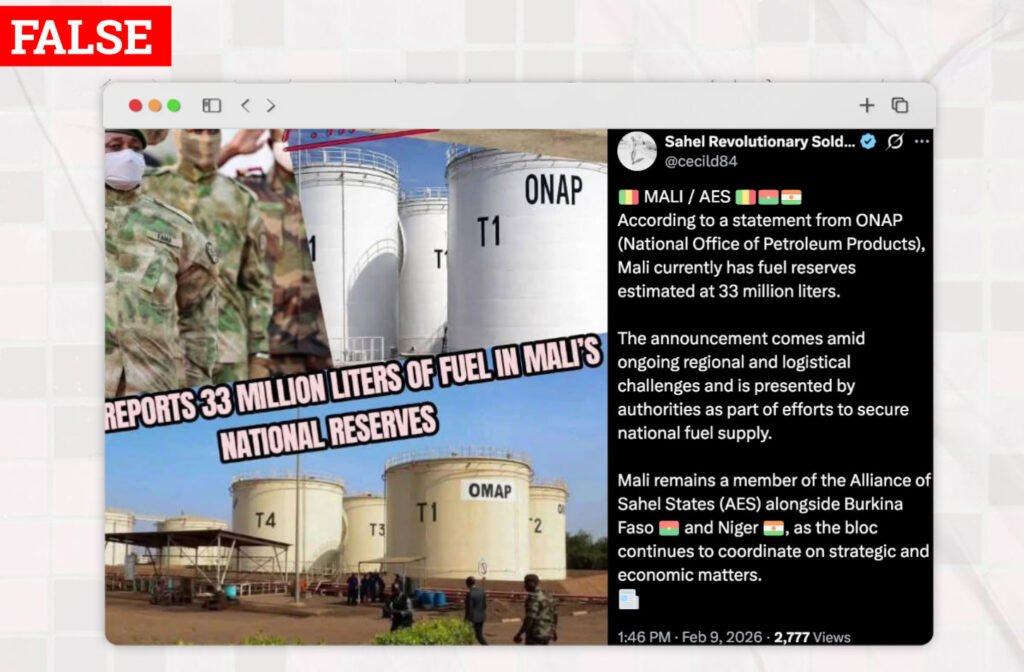
On February 9, 2026, an X user, @cecild84, claimed that Mali has a fuel reserve estimated at 33 million litres. The post which has images of Mali’s military leader, General Assimi Goïta and fuel farm, is captioned, “🇲🇱 MALI / AES 🇲🇱🇧🇫🇳🇪 According to a statement from ONAP (National Office of Petroleum Products), Mali currently has fuel reserves estimated at 33 million liters. The announcement comes amid ongoing regional and logistical challenges and is presented by authorities as part of efforts to secure national fuel supply. Mali remains a member of the Alliance of Sahel States (AES) alongside Burkina Faso 🇧🇫 and Niger 🇳🇪, as the bloc continues to coordinate on strategic and economic matters.📰”
When this report was published, the post had about 2770 views and over 160 replies, reposts, quotes, likes and bookmarks. In the comment section, @SamsonNyimu5 said “Excellent news Mali 🇲🇱.”
VERIFICATION
The Office Nationale des Produits Pétroliers, ONAP, in Mali is a national oil company that is responsible for the production, refining, marketing, and distribution of petroleum products in the country. The company is owned by the Government of Mali and is the sole operator of the oil industry in the country.
There is extensive, credible reporting that Mali is facing a serious fuel shortage, not abundant reserves. Multiple news outlets describe a fuel supply crisis throughout 2025–2026, largely driven by disruptions to imports due to armed groups blocking supply routes, attacks on fuel convoys, and rationing measures by the government. These reports do not support the idea that the country has a large strategic stockpile of fuel. In fact, they suggest scarcity and efforts to increase supply.
In January 2026, Mali imported over 54 million litres of petroleum products within ten days in an effort to ease the shortages and reduce long queues at service stations, a sign of crisis management rather than excess stock. News accounts mention fuel rationing and a push to improve distribution, again pointing to constrained fuel availability rather than ample reserves.
Mali is highly dependent on imported fuel. In 2025, militant groups carried out attacks on fuel convoys and enforced a blockade on import routes, causing shortages, long queues, and rationing. Efforts to build up fuel stocks are reported as responses to crisis conditions, not indications of large reserves already in place.
Comprehensive official data on fuel reserves like strategic petroleum stockpiles, days-of-supply, refined fuel inventories, or national emergency fuel reserves) for every African country is not compiled in one public source, and most countries do not publish daily/weekly fuel reserve figures. What is available reliably and consistently across the continent is proven crude oil reserves, geological totals of oil that can be produced, which are often used as a proxy for a country’s long-term energy resource base.
Most African countries do not publish detailed data on how much refined fuel they keep in strategic storage (e.g., days of consumption). Where available (e.g., in Nigeria and South Africa), estimates range from 20–30+ days of refined fuels under exceptional circumstances, but these figures are country-specific and not standardized continent-wide.
There are no authoritative energy sector reports or government statements widely published in reputable outlets confirming an exact figure of Mali’s strategic fuel reserves at 33 million litres as of early 2026.
CONCLUSION
The claim that Mali currently holds fuel reserves estimated at 33 million litres is FALSE based on available reputable sources. This lacks verification by mainstream media or official energy data, and contrasts with reporting about ongoing fuel shortages.