

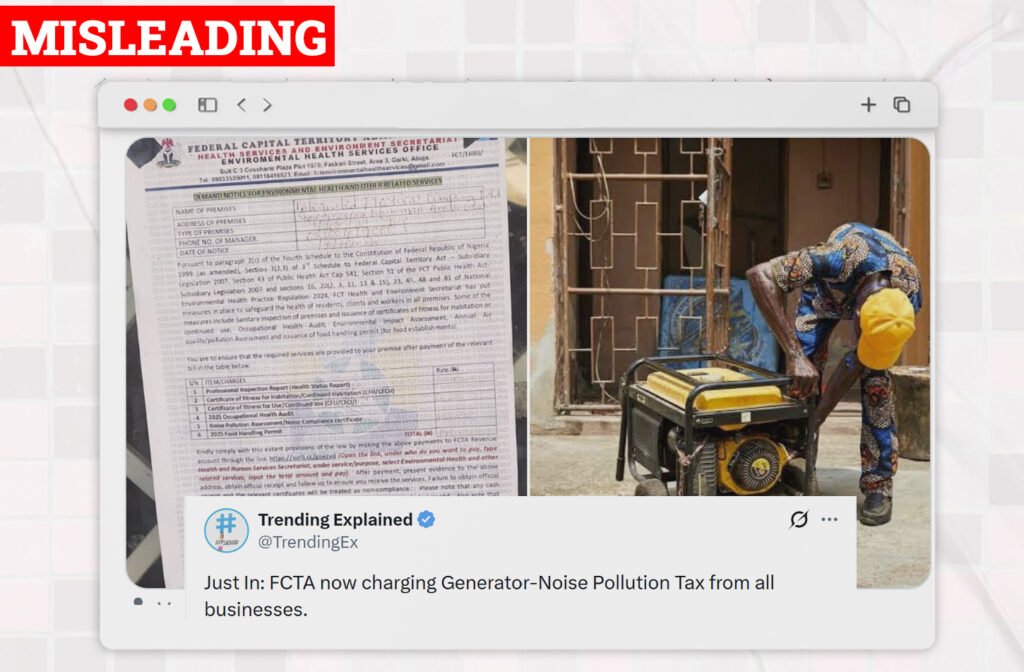
CLAIM: FCTA Imposes Generator Noise Pollution Tax On Abuja Residents
A page on X @TrendingEx has claimed that the Federal Capital Territory Authority, FCTA, now charges tax for generator noise pollution. The post, which had images of the notice and a man with his generator, was captioned “Just In: FCTA now charging Generator-Noise Pollution Tax from all businesses.”
When this report was published, the post had about 507,000 views and over 5,100 replies, repost, quotes, likes and bookmarks. In the comment section, @debayoorr wrote “You’re telling me the government failed to provide electricity, businesses had to self-fund power solutions, and now they’re being taxed for generator noise?” while @Yayaa__Ze said “Finally, a tax that acknowledges the true soundtrack of Nigerian business. Thank you FCTA for monetizing our SUFFERING & DESPAIR So the FCTA’s new revenue stream is literally just… NOISE? They taxed everything they can see now they are taxing everything they can hear 🤷”.
VERIFICATION
The fact-checker put the notice through Google reverse image search with results showing that this notice has been in circulation since September 2022.
Recently, similar notices have been circulating on social media platforms claiming that the FCTA is imposing a new tax fee on business owners for generator noise pollution. These posts include scanned notices stating that businesses will be charged for noise pollution caused by their generators.
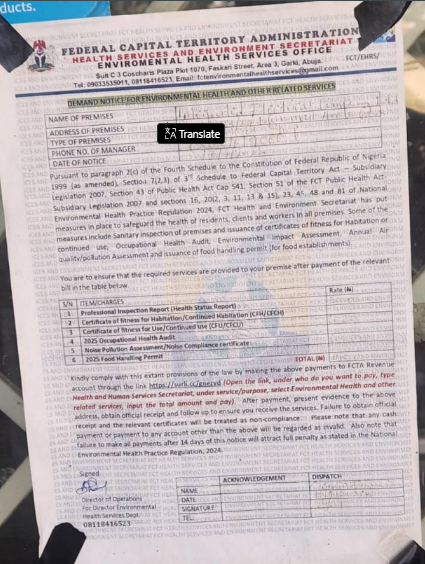
According to a report published recently by Sahara Reporters, the FCTA has directed public premises in Abuja to obtain health, environmental certificates or face penalties. This notice, which was issued by the Health Services and Environment Secretariat, requires public premises to obtain various environmental and health certificates, including noise pollution assessment or compliance certificates. Affected premises were told to make payments for these services to the FCTA revenue account. This directive is framed as part of environmental health compliance and certification requirements, rather than a standalone “noise tax.”
According to the Secretariat, the measures are aimed at safeguarding “the health of residents, clients and workers in all premises” across the Federal Capital Territory. The notice outlines mandatory services that premises are required to obtain, including sanitary inspection and the issuance of “certificates of fitness for habitation or continued use,” occupational health audit, environmental impact assessment, annual air quality and pollution assessment, as well as food handling permits for food establishments.
Moreover, Nigeria’s environmental law allows noise control through permits and compliance regimes (e.g., National Environmental (Noise Standards and Control) Regulations), which prescribe permissible noise levels and permit requirements for noisy activities. These permits involve payment of certain fees or levies, but they are standard regulatory processes rather than a new “generator tax.”
Mr. Hamzat Remi, a consultant with the FCTA said that “this levy has been in existence since 1960, and not during Tinubu’s tenure.” He stated that, “environmental health officers go on routine checks of premises to assess if there are hazards and when satisfied, a certificate is issued, after payment.” Remi continued that “the issued certificate lasts for 3 years, though inspection is a continuous process, since hazards can happen any time”. Hamzat concluded that, “during inspection business owners are advised not to allow noise from their generators and machines exceed 80 decibel, which is the recommended noise level”.
When this report was published, there was no verifiable official press release from the FCTA’s government website or mainstream news outlets clearly announcing a new “Generator Noise Pollution Tax”.
CONCLUSION
The claim that the FCTA now charges tax for generator noise pollution is MISLEADING. Although there are notices and requirements for businesses to pay for noise-related environmental compliance services in Abuja, these are not recent. Additionally, there is no official declaration from FCTA stating the introduction of a formal, standalone “Generator-Noise Pollution Tax” that applies to all businesses in Abuja as a new tax category.