
What The Nigerian Constitution Says About External Military Deployment
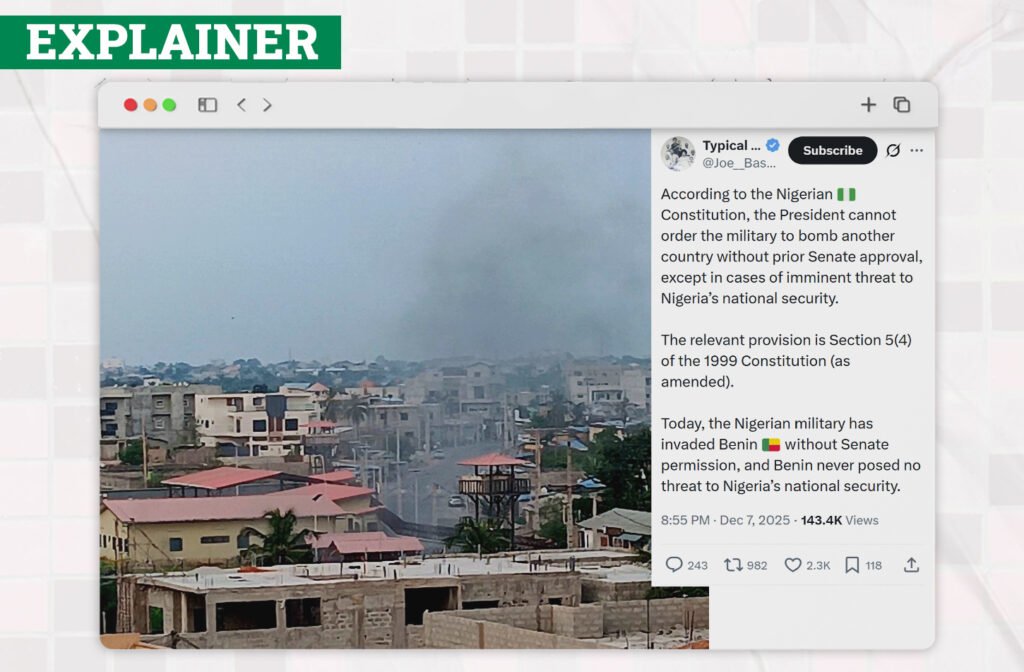
On December 7, 2025 an X user @Joe_Bassey made a claim that the Nigerian President cannot order the military to bomb or enter another country without Senate approval. This claim was also posted on Facebook by @biafranupdate. As the claim spread, interpretations of the Nigerian Constitution were mixed. Some commenters argued that Section 5 of the 1999 Constitution was an absolute restriction on presidential powers, while others argued that the President, as Commander-in-Chief, can act freely in security matters without legislative oversight. These conflicting narratives created confusion about what the Constitution actually permits, especially during emergency or security driven interventions. This explainer analyses what the Nigerian constitution says about military deployment for operations outside the country.
What The Constitution Actually Says
Section 5(4) states that the president must get the National Assembly’s approval before sending the armed forces outside Nigeria. This applies to any form of military deployment, whether peacekeeping, air operations, or combat missions.
This part of the Constitution gives the Senate the authority to check and approve any plan to send Nigerian troops into combat outside the country. In other words, the President cannot decide alone to use the military for foreign operations. The President must first seek and receive the Senate’s approval. This creates a balance of power, making sure decisions about external military action are not made by the executive alone.
How This Links Claim About Nigeria and Benin Republic
The statement being circulated says that Nigerian forces entered the Republic of Benin without Senate approval and that the Benin Republic did not pose any threat to Nigeria. This has attracted mixed feelings, from diplomats, political analysts and experts, calling on the Nigerian government to be strategic in its dealings with neighbours.
A statement on Sunday, December 7, from the office of President Tinubu’s said that Nigeria’s military intervened in Benin after President Patrice Talon’s government issued two requests for help, including for “immediate Nigerian air support.
Under Section 5(5) of the 1999 Constitution, the President can take immediate military action without first meeting or getting approval from the National Assembly only if there is an imminent threat or danger to Nigeria’s national security.
A coup in the Republic of Benin could create regional instability that affects border security, trade routes, and movements of people along their shared frontier. According to Usman Ibrahim, a Nigerian security analyst at SARI Global, an unrest in Benin poses a direct risk to Nigeria’s economic and security priorities, motivating a “fast Nigerian-fronted ECOWAS reaction,”.
CONCLUSION
Section 5 of the 1999 Constitution sets firm limits on how the president can deploy Nigeria’s armed forces outside the country. While foreign combat operations normally require the Senate’s prior approval, Section 5(5) allows the President to act immediately only when there is an imminent threat to Nigeria’s national security. Even in such emergencies, the president must notify the National Assembly quickly and seek their approval afterwards.