Has Burkina Faso Acquired All TotalEnergies Gas Stations In The Country?
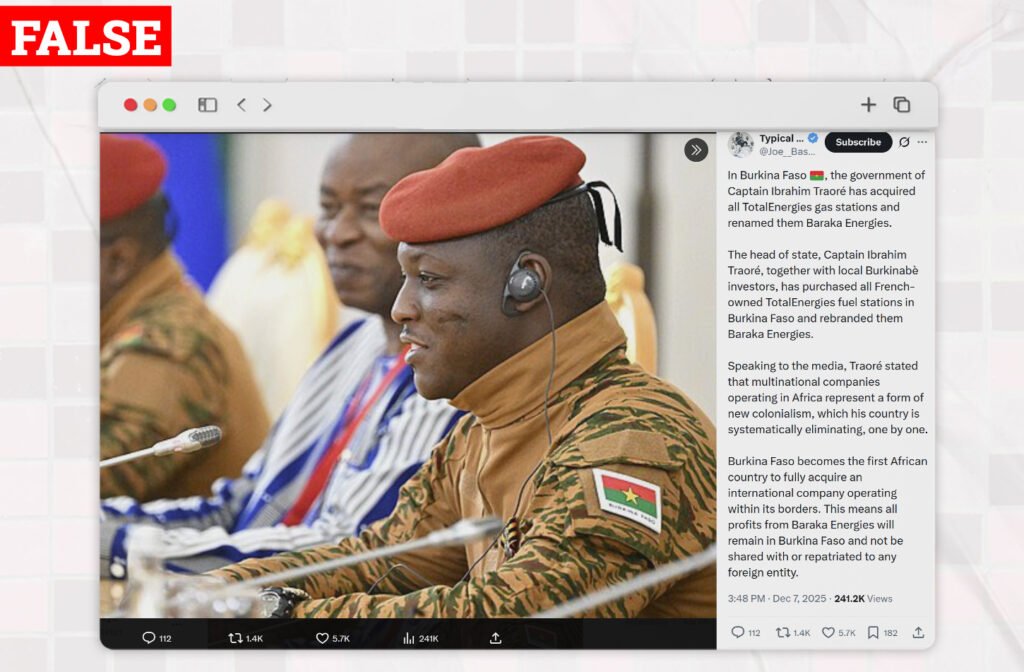
On December 7, 2025 an X user, @Joe_Bassey made a claim that the government of Captain Ibrahim Traoré personally acquired all TotalEnergies gas stations in Burkina Faso, rebranded them Baraka Énergies, and declared that Burkina Faso is the first African country to fully acquire an international company operating on its soil. The post had an image Ibrahim Traore image with the caption:
“In Burkina Faso 🇧🇫, the government of Captain Ibrahim Traoré has acquired all TotalEnergies gas stations and renamed them Baraka Energies. The head of state, Captain Ibrahim Traoré, together with local Burkinabè investors, has purchased all French-owned TotalEnergies fuel stations in Burkina Faso and rebranded them Baraka Energies. Speaking to the media, Traoré stated that multinational companies operating in Africa represent a form of new colonialism, which his country is systematically eliminating, one by one. Burkina Faso becomes the first African country to fully acquire an international company operating within its borders. This means all profits from Baraka Energies will remain in Burkina Faso and not be shared with or repatriated to any foreign entity.”
When this report was published, this claim had about 240,000 views and over 7,400 replies, reposts, quotes, likes and bookmarks. In the comment section, @joshuakamau said “Meanwhile, in a Kingdom far far away, the government decides to sell its share of the country’s most profitable company to foreigners at a throw away price.” and @ezinne_anne wrote, “I just hope this man lives. I hope they don’t mess him up or set him up”
VERIFICATION
CLAIM 1: Captain Ibrahim Traoré Personally Acquired All Totalenergies Gas Stations In Burkina Faso
VERIFICATION
FinancesAO reported that a local buyer acquired the assets of TotalEnergies’ downstream operations in Burkina Faso, and the business now operates under the name Barka Énergies, maintaining the retail service station network.
Billionaireafrica reports identify a local investor group, Coris Invest Group, CIG and similar Burkinabe investors, as the buyer. On September 8, 2025, Idrissa Nassa, CEO and founder, Coris Invest Group personally signed the paperwork that transferred control of TotalEnergies Marketing Burkina to Coris. This is contrary to the claim that the national government or Captain Ibrahim Traoré personally purchased the network.
Coris/Coris Holding, a well established firm in insurance and financial services, is now diversifying its activities towards energy with recent coverage noting that major external co-investors and development finance institutions are participating in capital rounds for Coris Holding. This includes Mediterrania Capital Partners and DFIs (FMO, British International Investment, BIO) and is an indication that CIG is not an isolated small buyer but part of a larger regulated financial group with international financing ties.
Available report show that the Burkinabè government was informed of, and present at, key stages of the transaction, but there is no evidence it owns or controls Coris Invest Group. Media accounts note that the Ministry of Industry and Trade was officially notified of the sale and that Burkina Faso’s embassy attended the signing ceremony in Dakar, indicating regulatory and diplomatic involvement typical of large cross-border deals.
There is no publicly disclosed transaction document that shows direct state equity or that the presidency holds a stake in CIG or in the new Barka Énergies entity.
VERDICT
The claim that Captain Ibrahim Traoré personally acquired all Totalenergies gas stations in Burkina Faso is FALSE. The station was acquired by private investors.
CLAIM 2: Burkina Faso Is The First African Country To Fully Acquire An International Company Operating On Its Soil
VERIFICATION
Across Africa there have been previous nationalisations, buyouts, and transfers of foreign-owned assets to local or state-controlled entities over many decades. This includes the Nigerian government nationalising the assets of British Petroleum in response to political tensions in 1979. The acquired assets were transferred to the Nigerian National Petroleum Corporation, NNPC. Ten years earlier, President Kenneth Kaunda of Zambia nationalised all major copper mining operations, which were previously owned by British and American firms such as Anglo American and Roan Selection Trust. These were consolidated under Zambia Consolidated Copper Mines (ZCCM).
Libya took control over large foreign-owned oil assets in the 1970s under Gaddafi’s rule. On Sept. 1 1973, Libya announced the nationalisation of 51 per cent of the assets of all the oil companies operating in the country.
On July 26, 1956, Egyptian President Gamal Abdel Nasser nationalised the Suez Canal Company, a joint British-French enterprise that had owned and operated the canal since its construction in 1869. Kwame Nkrumah’s government established state control over several key economic sectors and bought out certain foreign enterprises, including the Ghana Cocoa Marketing Board, the Ashanti Goldfields Corporation, and the Bibiani (1927) Ltd mines. His overall policy aimed to reduce foreign economic dominance and promote industrialisation. However, the purchase of TotalEnergies was made by a private individual not the government.
VERDICT
The claim that Burkina Faso is the first African country to fully acquire an international company operating on its soil is FALSE. Even if Burkina Faso had acquired TotalEnergies Gas Stations, it will not be the first African country to acquire international companies operating on its soil.
CONCLUSION
The claims that the government of Traoré personally acquired all TotalEnergies gas stations in Burkina Faso and it is the first country to acquire international companies on its soil are FALSE. TotalEnergies gas station was acquired by private ownership not government. Also, historical evidence shows that several African nations, including Nigeria, Zambia and others had previously nationalised, bought out or taken full control of foreign-owned companies.