
Smoke and Mirrors: Misinformation and Public Perception of Military Coups in Africa
The resurgence of military coups across Africa in recent years has been widely analysed as a political and security phenomenon. From Mali in 2020 and 2021 to Guinea in 2021, Burkina Faso in 2022, and Niger in 2023, the continent witnessed a renewed wave of unconstitutional changes of government. According to the African Centre for the Constructive Resolution of Disputes (ACCORD), Africa recorded more successful coups between 2020 and 2023 than in the previous two decades combined.
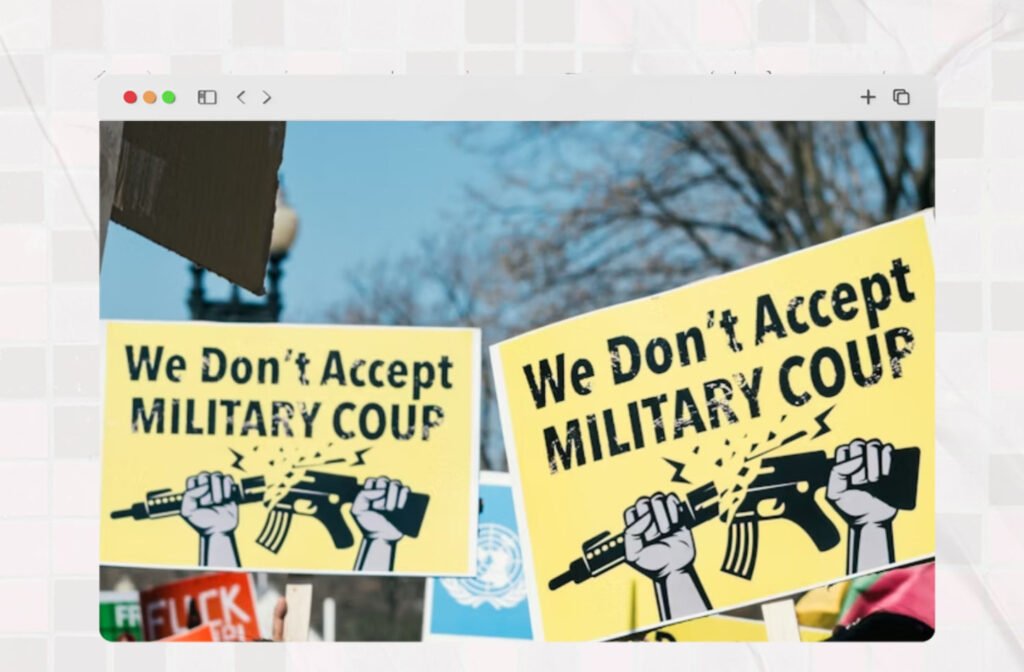
Africa’s return to military coups is not only a political crisis, but an information crisis as well. Military takeovers now unfold in an era defined by digital media, fragmented information systems, and declining trust in traditional institutions. Rather than facing uniform resistance, recent coups were greeted with public celebrations, viral online support, and narratives that portray soldiers as national redeemers.
Dominant Narratives Surrounding Coups in Africa
The “Military as Saviour” Narrative
One of the dominant narratives deployed presents the military as a neutral force working to rescue failing states. Historically, coup leaders often justified their actions as corrective interventions against corruption or ineffectiveness.In contemporary contexts, the same narrative has been repackaged on digital platforms, for a broader audience.
Following the 2020 coup in Mali, online campaigns framed the military as patriots responding to widespread frustration with President Ibrahim Boubacar Keïta’s administration. Similar rhetoric emerged in Burkina Faso, where coup leaders positioned themselves as defenders against jihadist violence.
The Coup as “Popular Revolutions” Claim
A second pervasive disinformation tactic that has emerged is equating military takeovers with popular revolutions. In several cases, visuals from public demonstrations, edited or taken out of context, circulate widely as evidence of overwhelming public support for coup leaders.
Misinformation in Niger following its 2023 coup illustrates this dynamic. Social media was flooded with manipulated videos, false rumours, and misleading audio clips that were used to frame the military takeover as an expression of the people’s will, often tied to anti-Western sentiment. Analysts found that numerous accounts promoted exaggerated or fabricated portrayals of mass support for the junta.
False coup rumours have also spread even in countries without a military takeover. In Ivory Coast, fabricated videos and posts claimed that soldiers were seizing key institutions. The claim spread quickly on TikTok and other platforms, highlighting how coup narratives can become a crisis.
Producers and Amplifiers of Coup Misinformation
Domestic Political Actors and Power Brokers
Domestic elites often have incentives to promote narratives that legitimise military intervention. Politicians sidelined by democratic processes or weakened by corruption scandals may amplify claims of civilian incoherence or impending collapse to justify coups. In Mali, authorities have banned independent outlets and arrested critics who challenge official narratives, weakening the space for alternative perspectives.
Digital Platforms and Transnational Information Flows
In the Sahel, Pro-Russia and anti-Western networks promote anti-Western frames around coups, even when these claims lack substantiation. These disinformation campaigns are circulated on digital platforms, particularly encrypted messaging apps where fact-checking is harder and misinformation spreads unchecked.
Cross-border disinformation reveals there are broader geopolitical contests that tap into real public frustrations with governance, insecurity, or foreign military presence. This blend of emotional resonance and falsehood shape perceptions around military takeovers.
Impact on Democracy and Development
Repeated exposure to misleading narratives that justify military rule as inevitable or beneficial weaken public resistance to coups. An academic survey of recent coups in Africa concluded that democracy in Africa has declined in contexts where corruption, insecurity, and economic hardship are high, and where military takeovers are framed as effective alternatives. According to Afrobarometer and reporting by The Guardian, support for democratic rule has fallen in countries like Mali as acceptance of military governance grows amid frustrations with civilian leadership.
Yet, studies have found that military rule often fails to resolve the very problems used to justify coups. In Mali, independent analysis shows that extremist violence and instability have increased since the 2020 coup, undermining claims that the military can deliver better security than democratic governments. Similarly in Burkina Faso, military leaders extended the transition back to civilian rule by five years, citing security concerns as a justification while violence tied to jihadist insurgents worsens. Reuters reports that thousands of civilians were killed amid escalating conflict under junta control.
Conclusion
The recent wave of coups in Africa cannot be understood solely through the lens of political events on the ground. The information ecosystem is rife with misleading narratives that glorify military intervention and distort public perception, playing a crucial role in how these events are received and justified. Disinformation does not merely distort narratives. It frames military rule as a necessary response to democratic failure, amplifying certain grievances while obscuring the failings of authoritarian alternatives.
The reality underscores a need to confront the “smoke and mirrors” of disinformation, to address the growing popularity of coups and military regimes. Stakeholders must also strengthen journalism, promote media literacy, and enable transparent public discourse to support citizens in critically assessing claims about governance, whether advanced by democrats or men in military uniform.