

CLAIM: NASA’s 2025 Temperature Report Did Not Mention Climate Change
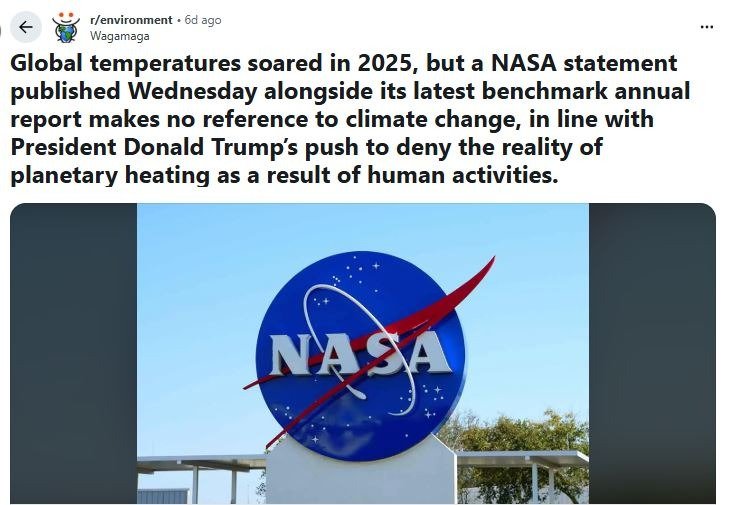
Reddit user, wagamaga has claimed that a NASA statement released with its annual report made no reference to climate change, and that this was done deliberately to align with the political agenda of denying human-caused warming. This claim, shared on January 15, 2026, was picked from Climate SpotAI, a disinformation tracker tool.
VERIFICATION
Multiple scientific monitoring groups reported that 2025 was among the warmest three years on record globally, with surface temperatures well above long-term historical averages. Independent datasets from agencies such as Copernicus (the European climate tracking service), the UK Met Office, and the World Meteorological Organisation show a continuation of long-term warming trends driven by greenhouse gas increases. The average global surface temperature was significantly above pre-industrial levels, continuing a decades-long pattern of warming.
Additional analyses from earth.org confirm that 2025 finished as the third-warmest year since records began in the mid-19th century, following exceptionally warm years in 2024 and 2023. According to NASA, this ongoing increase fits the well-established global warming trend that scientists have linked to rising concentrations of carbon dioxide and other greenhouse gases from human activities.
In January 2026, NASA released its annual global temperature data confirming that 2025 was among the warmest years on record, yet the agency’s official public statement notably omitted explicit references to “climate change,” “global warming,” or human-driven causes.This approach marked a significant departure from previous years’ communications, which typically highlighted the long-term warming trend driven by greenhouse gas emissions.
However, there is no evidence that NASA’s underlying global temperature data or scientific analyses have been changed to deny climate science. The agency’s core climate research continues to be built on openly published data and peer-reviewed methods. What changed in this specific statement was the language used in the press release, not the science supporting the temperature measurements. Reports about omissions in wording reflect perceptions about communication choices under a particular administration, not a shift in scientific evidence.
CONCLUSION
The claim mixes accurate information with misinterpretation. It is TRUE that global temperatures in 2025 were exceptionally high, ranking among the warmest years ever recorded, and this fits into a long-established pattern of global warming. It is also TRUE that a NASA statement released alongside its annual temperature data did not explicitly mention climate change or human causes, which observers described as unusual. However the suggestion that it was done in line with a political agenda or shift reflects the perspective of the commentator.